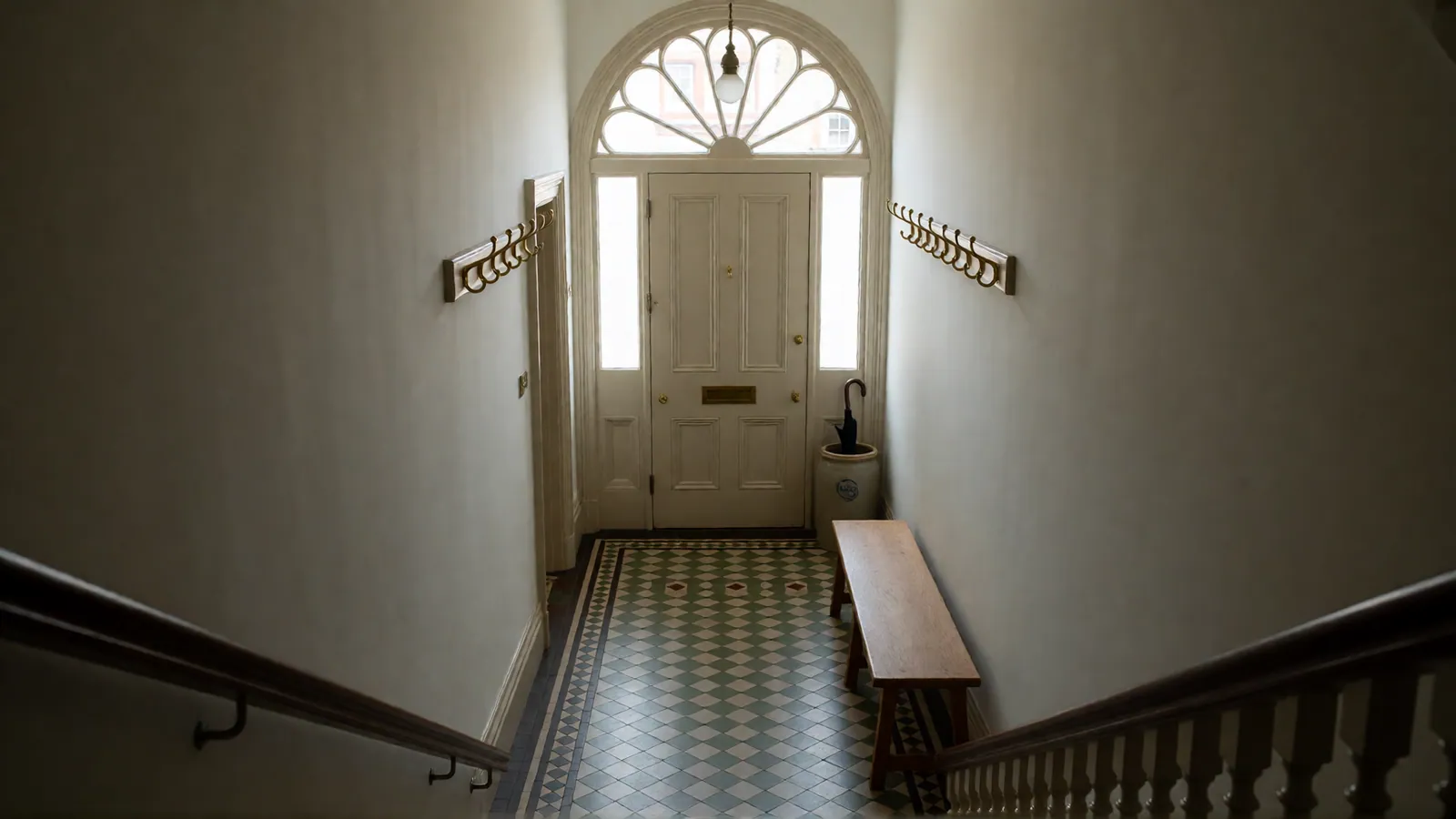
What replaces the counter
Arriving at a house with no front desk
What replaces the person behind the counter is a written arrival, sent a week early, with photographs. It works better than the counter did.
What a front desk actually does
A front desk is not really about the desk. It is a person who confirms you are expected, hands you a key, tells you which floor and points you at the lift. Remove the desk and all four of those jobs still have to happen; they simply happen a different way, and a house that removes the desk without replacing those four jobs is the version of "no front desk" that actually goes wrong at the door.
The written arrival
The sequence starts a week before anybody arrives rather than at the door, because the useful parts of a check-in — which door, what the code is, what to do if it does not answer — are far easier to absorb calmly at home than standing on an unfamiliar step at night with a case in each hand.
- Seven days before The arrival note arrives by e-mail: the door code, which door it opens, the photographs of the entrance, and what to do if the code does not work.
- The day of arrival The code works from three in the afternoon. There is nobody to meet — the door is a keypad and it is the only key there is.
- Inside The apartment is yours. Nobody enters during a stay unless you ask, and the cleaner does not come mid-stay on a booking of under seven nights.
- The morning you leave Out by eleven, the code stops working at eleven, and the bins go in the store under the stoop. There is no key to hand back.
Each of those steps is doing one of the front desk's four jobs without a person standing behind a counter to do it: the note a week ahead confirms you are expected and shows you, in advance, what the desk would otherwise show you on arrival; the code that starts working at three in the afternoon is the key, given before you need it rather than handed over the moment you do; and the instructions photograph the door itself, which is the part a verbal direction from a desk clerk usually gets wrong anyway.
Why this works better than the counter it replaces, not merely as well
A front desk is only open for the hours somebody is paid to staff it, and arriving outside those hours at a hotel with a genuine night desk is still an arrival that depends on a stranger's mood at one in the morning. A code sent a week in advance and working from mid-afternoon has no hours at all — it works identically at three in the afternoon and at three in the morning, for a guest whose flight was delayed exactly as well as for one who arrived on time. The absence of a person removes the one part of a hotel arrival that a schedule cannot actually guarantee.
What if you would simply rather talk to somebody
This arrangement is not for every guest, and saying so plainly is more useful than pretending it suits everybody equally. Somebody who wants a face at the door, a hand with the bags, or reassurance in person before they commit to a strange building at night is describing a real preference that a keypad and a written note do not satisfy, however well either one is executed. This house is not built to be that, and the honest advice for somebody who knows that about themselves is to book somewhere staffed, rather than to book here and hope the arrangement grows on them by the second night.
For most guests it does the opposite of what a first read suggests: nobody has to wait for a desk to open, nobody has to carry luggage past a lobby full of strangers, and a case can be left in the stoop store before check-in or collected from it after checkout without asking anybody's permission at all. What a counter offers as a courtesy, an unattended arrangement offers as a default.
What happens if something goes wrong at night
There is no front desk and nobody sleeps in the building. If something goes wrong at two in the morning the telephone is answered by a person who lives twenty minutes away, and that is what a small guest house can promise rather than a night porter it does not employ.
That is a genuinely different promise from a night porter, and it is worth being plain about the difference rather than implying the two are equivalent. A telephone answered by somebody twenty minutes away is what a house of this size can honestly offer; it is not a person standing in the building at two in the morning, and nothing on this site claims otherwise. What a hotel offers that this house does not says the rest of that comparison plainly.
What this means for a first-time guest
Read the arrival note when it arrives rather than the week you check in, because the useful part of it — the photograph of the actual door, which door among several it is, and what to do if the code does not respond on the first try — is meant to be absorbed before the taxi rather than read on the doorstep at night. Self check-in, in full and house rules cover everything else a front desk would otherwise explain in person.
Where this bears
The pages this argument touches
Check the dates you want
The calendar is live. It shows what is free, it will not sell the same night twice, and it prints the whole total — cleaning fee included — before it asks for a name.